
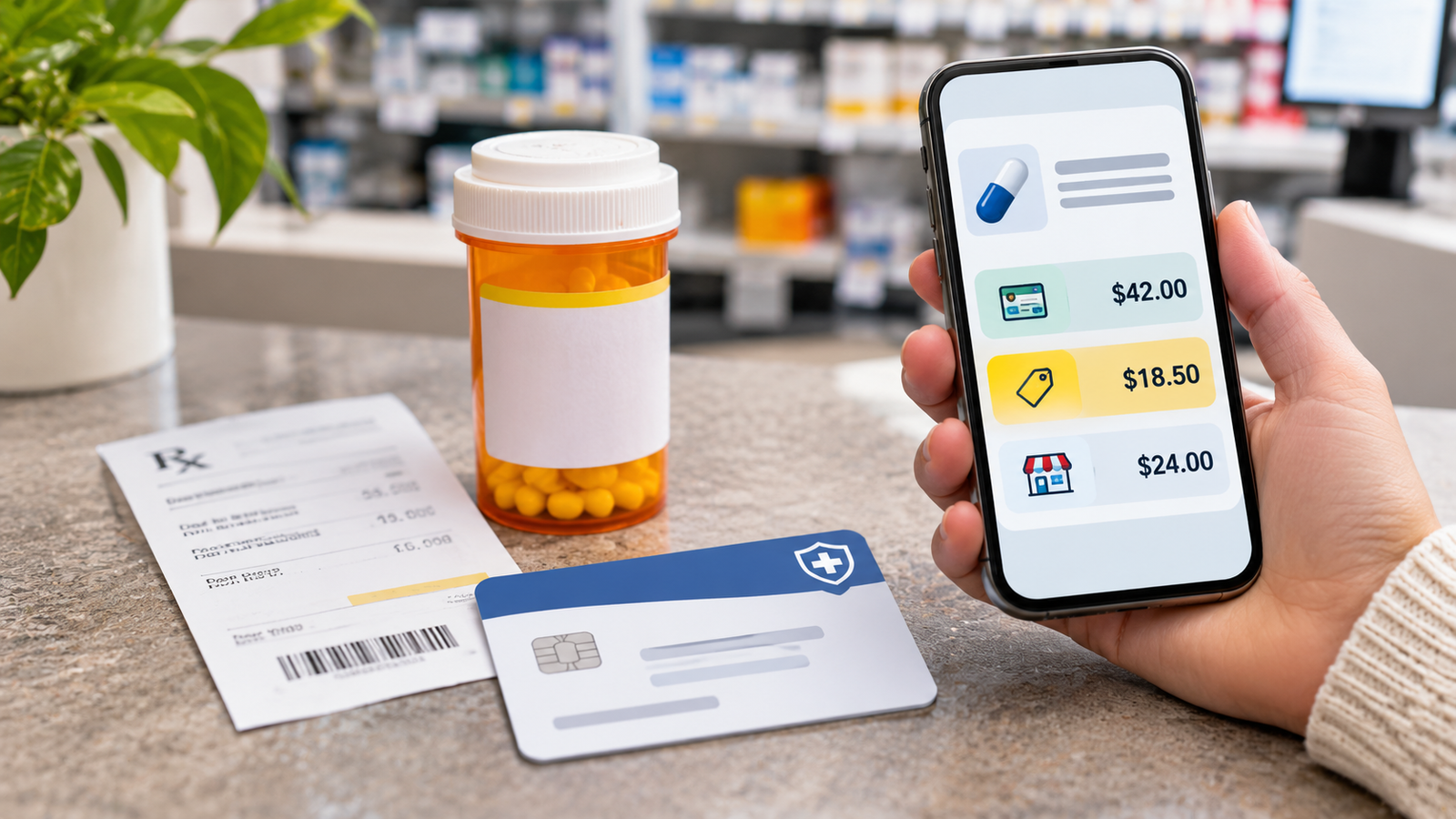
Short answer: You generally cannot use a GoodRx coupon and a health insurance claim for the same prescription transaction. At the pharmacy, the prescription is normally processed either through your insurance plan or through the GoodRx discount price, not both at once. You can, however, compare the two prices before deciding which payment method makes more sense.
Having insurance does not guarantee that every medicine will have the lowest possible out-of-pocket price. A plan may exclude a drug, place it on a higher formulary tier, require a deductible, or charge a copay that is greater than a discount-card price. Understanding the difference helps you make an informed choice without accidentally giving up benefits you need.
Prescription pricing depends on the specific medicine, pharmacy, coverage terms and discount eligibility. For the underlying guidance, consult GoodRx’s explanation of savings with insurance, GoodRx coupon guidance, and Medicare’s Part D guidance.
How GoodRx works alongside health insurance
GoodRx provides prescription price information and discount coupons negotiated with participating pharmacy benefit managers and pharmacies. It is not health insurance and does not pay a claim on your behalf. When you present a GoodRx coupon, the pharmacy processes the purchase using the discount program’s pricing arrangement. That transaction replaces the insurance claim for that fill.
Insurance works differently. Your pharmacy submits a claim to the plan, and the plan applies its formulary, negotiated rates, deductible, copayment or coinsurance rules. Since these are separate payment routes, a pharmacy generally cannot stack a GoodRx coupon on top of an insurance copay for the same prescription.
When should you compare GoodRx with insurance?
1. Your prescription is not covered
If a medicine is excluded from your formulary or requires prior authorization that has not been approved, the insurance price may be unavailable or very high. A GoodRx discount may offer a lower cash price. Ask the pharmacist to compare the coupon price with the actual amount due under your plan.
2. Your deductible has not been met
With a high-deductible health plan, you may pay much of the negotiated prescription cost until you satisfy the deductible. A discount price can sometimes be lower. But there is an important trade-off: a purchase made outside the plan usually does not automatically count toward the deductible or annual out-of-pocket maximum. Check your plan’s rules before choosing the coupon.
3. Your copay is higher than the discount price
For some generic medicines, a pharmacy’s discount price may be less than the insurance copay. Compare the final price for the exact strength, dosage form, quantity and pharmacy. Prices can vary by location and may change, so do not assume a price displayed earlier is guaranteed at checkout.
4. Your insurance claim is rejected
A rejected claim may result from eligibility, refill timing, quantity limits, formulary restrictions or data-entry issues. Ask the pharmacist why it rejected. A coupon may help with an immediate cash purchase, but it does not resolve the underlying coverage issue. Contact the insurer or prescriber if the medicine should be covered.
Does GoodRx count toward your deductible?
GoodRx states that purchases made using its discount generally do not automatically count toward a health plan deductible. They also may not count toward the plan’s out-of-pocket maximum. This is because the pharmacy processes the purchase outside the insurance benefit. If accumulating deductible credit is important, ask your insurer whether it accepts any documentation or exception process for out-of-network or cash purchases. Do not assume reimbursement is available.
How to compare the two prices safely
- Ask the pharmacy to run the prescription through your insurance and tell you the actual patient cost.
- Check GoodRx for the same drug, strength, dosage form and quantity at that pharmacy.
- Compare the total price, not a headline price for a different quantity or formulation.
- Ask whether using the discount changes deductible or out-of-pocket tracking.
- Confirm whether the prescription has refill restrictions, prior authorization or quantity limits.
- Choose one payment route for that fill and keep the receipt.
Can you use GoodRx with Medicare or Medicaid?
Rules can differ by program and by the individual’s coverage. GoodRx is not a substitute for understanding Medicare Part D or Medicaid requirements. A person enrolled in a federal or state health program should ask the pharmacist and plan administrator how a discount-card transaction affects that coverage and whether the medicine should instead be billed to the plan. Do not misrepresent coverage or ask a pharmacy to submit the same fill twice.
Can you use GoodRx and an HSA?
GoodRx notes that an eligible prescription purchased with its discount may be paid for using a Health Savings Account, subject to HSA rules. An HSA is a way to pay eligible expenses with qualifying account funds; it does not combine the GoodRx discount with an insurance claim. Keep itemised receipts and confirm eligibility with your HSA administrator or tax adviser.
Questions to ask your pharmacist
- What is my exact insurance copay for this fill?
- Is the medicine covered and is prior authorization required?
- What is the GoodRx price for the same quantity and formulation?
- Will a discount-card purchase count toward my deductible? Usually it will not, but verify your plan’s rules.
- Are there manufacturer assistance programs or lower-cost generic alternatives my prescriber can consider?
For broader context, explore our finance coverage, lifestyle articles, and business guides.
Frequently asked questions
Can a pharmacy apply GoodRx after insurance?
Usually not to the same prescription transaction. The pharmacy normally processes either the insurance claim or the GoodRx discount. Ask the pharmacist to explain the available options before the sale is completed.
Can I use GoodRx if I have insurance?
Yes. Having insurance does not prevent you from comparing GoodRx prices. You may choose the discount instead of insurance for a particular fill when permitted and financially sensible.
Will GoodRx lower my insurance copay?
It does not normally reduce the copay within the insurance claim. It offers a separate discount price that you can compare with the copay.
Does GoodRx count toward my deductible?
Generally, no. GoodRx says discount purchases do not automatically count toward your deductible. Confirm details with your insurer.
Can I use GoodRx for a medicine my plan does not cover?
Often, a discount coupon can be used for an eligible prescription even if insurance does not cover the medicine. The pharmacy must confirm the coupon is accepted for that drug and fill.
Conclusion
You can have health insurance and still use GoodRx, but the coupon and insurance generally cannot be combined on the same fill. Compare the real copay with the discount price, consider the effect on deductible credit, and ask your pharmacist to explain the transaction before paying. For coverage questions, confirm details directly with your insurer.
